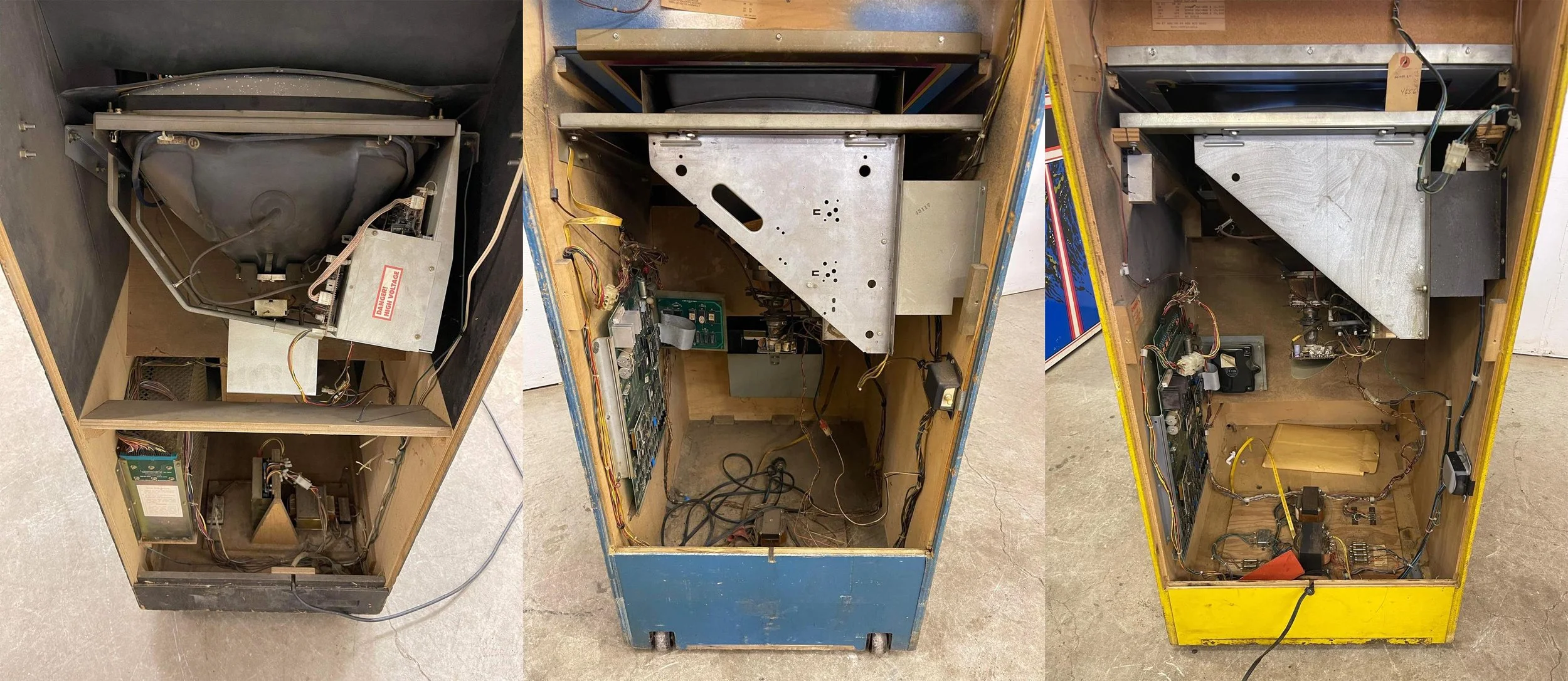
Image credit: Bitvint
Why Original Arcade Hardware Feels Different Than Modern Reproductions
To most people, an arcade game is just software.
If the game boots up and the controls work, it feels “the same.”
But anyone who grew up in real arcades — or anyone who has spent time around original machines — knows that authentic arcade hardware feels fundamentally different from modern reproductions.
That difference is not nostalgia.
It’s engineering.
At Deep 6 Arcade, preserving original hardware matters because arcade games were designed as complete physical systems — not just ROM files running on a screen.
The monitor, controls, cabinet, speakers, power supply, and even the electrical timing all contributed to the experience players remember.
And once you replace enough of those components, the feeling changes.
Arcade Games Were Built Around CRT Technology
Classic arcade games were designed specifically for CRT monitors.
Not adapted to them.
Designed around them.
CRT displays handled:
motion,
brightness,
color blending,
contrast,
and refresh timing
in completely different ways than modern LCD screens.
A CRT draws the image line-by-line using an electron beam directly onto phosphors inside the glass.
LCDs work by refreshing a fixed digital image through a backlit panel.
That difference changes everything.
Motion Clarity Was Dramatically Better
One of the biggest differences people subconsciously notice is motion clarity.
Original CRT arcade monitors had:
near-instant pixel response,
no motion blur processing,
no image scaling delay,
no digital smoothing.
Fast-moving games like:
Defender
Robotron: 2084
Track & Field
Daytona USA
were built expecting the motion behavior of CRT technology.
Modern LCD replacements often introduce:
input latency,
frame buffering,
motion smearing,
incorrect refresh synchronization.
Even tiny delays change how arcade games feel.
Competitive players notice immediately. If your local arcade uses LCD monitors, your ability to compete against historical scores will not be possible.
Scanlines Weren’t a “Visual Effect”
Modern reproductions often try to fake scanlines using filters.
But real CRT scanlines were not an overlay.
They were part of how the image physically existed.
Developers used scanlines intentionally:
to blend colors,
create shading,
smooth sprite edges,
and increase perceived detail.
Pixel art was designed with CRT behavior in mind.
On modern displays, many classic games appear overly sharp, flat, or sterile because the original visual blending no longer happens naturally.
Original Controls Had Mechanical Personality
Authentic arcade controls were physical industrial components.
Not generic USB devices.
Classic cabinets used:
leaf-switch buttons,
Cherry microswitches,
optical spinners,
weighted trackballs,
analog steering systems,
heavy spring-loaded joysticks.
Each game was tuned around specific control resistance, throw distance, and mechanical feedback.
A reproduction cabinet may technically “work,” but incorrect controls can completely alter gameplay feel.
That matters more than most people realize.
Cabinet Design Was Part of Gameplay
Arcade cabinets were not generic boxes.
Each machine had:
specific monitor angles,
speaker placement,
control panel heights,
cabinet depth,
lighting,
side art,
and physical ergonomics.
Games were designed around how players physically interacted with the cabinet.
For example:
sit-down racing games created immersion through enclosure,
vector games used deep monitor positioning,
multiplayer cabinets encouraged crowd formation,
pinball machines used body posture and physical nudging as part of gameplay.
A ROM running on a flat LCD inside a generic cabinet misses much of that physical design language.
Arcade Audio Was Analog and Aggressive
Original arcade audio systems were loud by design.
Developers expected games to compete for attention inside noisy arcades.
Many original cabinets used:
dedicated analog amplifiers,
large cabinet resonance chambers,
custom speaker layouts,
and raw, uncompressed sound output.
Modern reproductions often sound cleaner — but less alive.
Original arcade sound was meant to cut through a room full of machines and physically grab your attention.
That roughness was intentional.
Emulation Is Incredible — But It Still Isn’t Identical
Modern emulation is genuinely impressive.
Without it, many games would be lost forever.
But there is still a difference between:
preserving software,
and preserving hardware.
Authentic arcade restoration preserves:
electrical timing,
display behavior,
control feel,
audio characteristics,
cabinet ergonomics,
and the physical atmosphere the games were originally built around.
That’s why original machines continue to feel special decades later.
Why Authentic Hardware Still Matters
At Deep 6 Arcade, we believe arcade games are historical industrial art pieces — not just downloadable software.
Keeping original hardware alive requires:
monitor repair,
power supply rebuilding,
board-level troubleshooting,
control restoration,
cabinet preservation,
and constant maintenance.
It’s harder.
It’s slower.
It’s more expensive.
But it preserves the experience the way the games were actually intended to be played.
And once you experience original arcade hardware side-by-side with a reproduction, the difference becomes very hard to ignore.