Robotron Cannot Be Played Just Anywhere
Why Robotron: 2084 Can Only Truly Be Played on Original Arcade Hardware
There are plenty of ways to play Robotron: 2084 today — emulators, console ports, MAME cabinets, Raspberry Pi builds, modern fight sticks, and recreated arcade cabinets.
But there is only one way to actually experience Robotron the way it was designed, balanced, and mastered:
On an original Williams arcade machine.
At Deep 6 Arcade, we believe certain arcade games cross the line from “video game” into historical physical experiences — and Robotron: 2084 is one of the most important examples ever made.
The Controls Are the Game
The biggest reason modern versions fail to recreate Robotron is simple:
The original control system is inseparable from the gameplay itself.
Original WICO Leaf-Switch Joysticks Matter
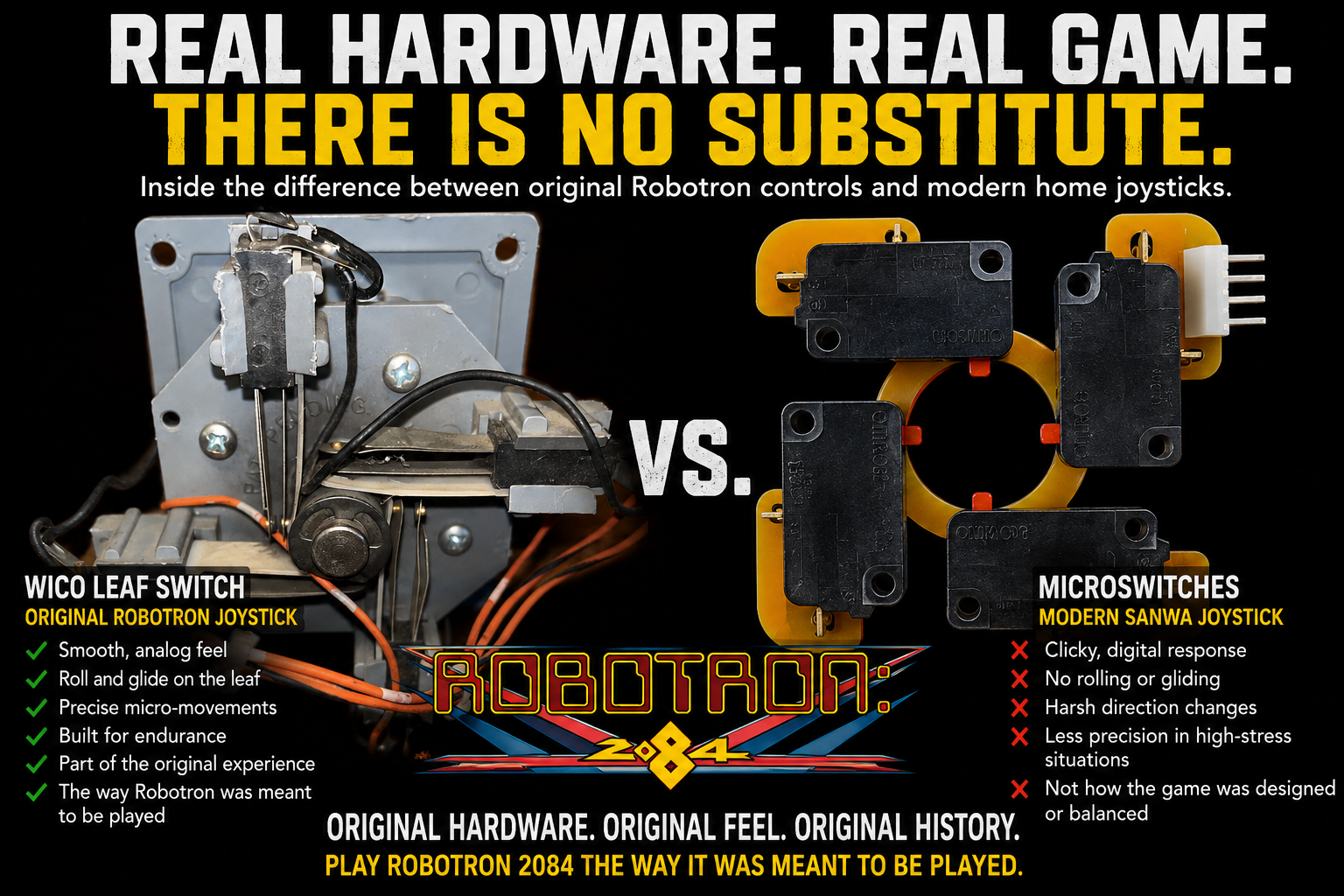
Original Robotron cabinets used heavy-duty WICO leaf-switch joysticks. These were not modern clicky microswitch sticks like Sanwa or Happ Competition controls.
That difference changes everything.
The original WICO sticks allow players to:
Roll the joystick diagonally along the actuator edge
Feather movement with pressure instead of hard clicks
Glide between directions
“Float” through movement transitions
Control tiny directional corrections during panic situations
Modern Japanese-style SANWA sticks are designed for precision fighting-game inputs. They use very short throws and microswitch activation with distinct clicking points.
That sounds good on paper — but it fundamentally changes Robotron.
Why Microswitch Sticks Feel Wrong for Robotron
With modern sticks:
Inputs activate more abruptly
Direction changes are harsher
Diagonal transitions feel digital instead of analog-like
Micro-corrections become harder
Fatigue increases during high-level survival play
Original WICO leaf-switch sticks have a softer engagement feel and a wider motion arc. Elite Robotron players often “ride” the edges of the joystick movement zone in ways that modern controls simply do not reproduce accurately.
In a game where survival is measured in milliseconds and movement precision, the joystick is not just an input device.
It is part of the game’s physics.
The Cabinet Height and Stance Matter More Than People Realize
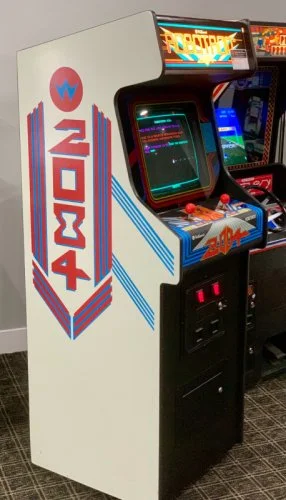
An original Robotron cabinet places the player at a very specific posture and body angle.
That sounds minor until you play for real.
The height of the control panel, the spacing of the joysticks, and the standing position create a unique physical rhythm that players unconsciously adapt to.
Competitive players develop:
Arm positioning memory
Shoulder tension habits
Wrist angle techniques
Weight shifting during panic waves
Muscle-memory timing tied to the cabinet geometry itself
Even small differences in cabinet height or joystick spacing can affect high-level play consistency.
When you stand at an original cabinet, you are standing exactly where players stood in 1982 while setting the scores that built arcade history.
That continuity matters.
CRT Monitors Are Faster Than LCDs for This Game
One of the most misunderstood downgrades in modern arcade recreations is the display.
Original Robotron hardware used CRT monitors — and CRTs behave fundamentally differently from LCD panels.
CRT Advantages for Robotron
CRT displays provide:
Virtually instantaneous pixel response
No sample-and-hold blur
Natural motion clarity
Near-zero display latency
True scanline rendering behavior
Proper phosphor glow and decay
In a game as violently fast as Robotron, motion clarity is survival.
LCD displays introduce:
Input lag
Motion smearing
Frame persistence blur
Scaling artifacts
Incorrect sprite sharpness
Timing inconsistencies
Even a few milliseconds matter when escaping a brain swarm or threading between tanks and grunts at high wave counts.
The original CRT image was part of the game’s tuning.
The Original Audio Hardware Creates Pressure
Williams arcade hardware had an aggressive sound profile that modern reproductions rarely recreate accurately.
Original cabinets produce:
Sharp synthesized effects
Loud transient spikes
Cabinet resonance
Bass vibration through the wood structure
Physical audio presence
The game feels more stressful — in the best possible way.
Modern emulation often cleans up or softens the sound unintentionally, reducing the psychological intensity that made Robotron legendary.
Latency Stacks Up in Modern Setups
Most modern recreations introduce delay at multiple levels:
USB encoder latency
Emulator processing latency
LCD display latency
Operating system overhead
Frame buffering
Wireless controller delay
Individually these delays seem tiny.
Together they change gameplay timing enough that original high-score muscle memory no longer transfers perfectly.
That is why comparing emulator scores directly to original arcade scores becomes problematic.
The experience is no longer technically identical.
Difficulty Balance Was Built Around Original Hardware
Robotron is one of the most precisely balanced arcade games ever created.
The enemy speed, bullet spacing, movement feel, and reaction timing were tuned around:
Original joysticks
Original monitor response
Original CPU timing
Original cabinet ergonomics
Original audio pressure
Change any one of those and the gameplay subtly shifts.
Change all of them — as most modern ports do — and you are effectively playing a different version of the game.
Historical High Scores Should Respect Original Hardware
This is why many serious arcade preservationists believe original-hardware scores and emulator scores should remain separate categories.
Playing Robotron on:
LCD screens
Modern joysticks
USB encoders
Emulator timing
Home console ports
…is not the same physical or technical challenge as playing on original Williams hardware.
That does not make modern versions “bad.”
But they are not historically equivalent.
The original arcade machine is the actual instrument the game was composed for.
Everything else is a cover version.
Why Preservation Matters
At Deep 6 Arcade, we believe preserving original arcade hardware matters because these machines are more than software.
They are complete physical systems.
The cabinet, monitor, controls, audio, timing, and feel are all part of the artwork itself.
And for games like Robotron: 2084, preserving that authenticity is the difference between merely playing the game…
…and experiencing one of the greatest arcade machines ever built.